Postdoctoral Fellow
Hi, I'm Kam-Kwai
I am a Postdoctoral Fellow at HKUST VisLab, where I work with Prof. Huamin Qu. I completed my bachelor’s and Ph.D. in Computer Science and Engineering from HKUST.
I build visual and immersive tools that help people understand complex information and make better decisions together. My work combines data visualization, immersive technology, and human-centered design to make complex and changing situations easier to see, discuss, and act on. I create systems that help people explore data more effectively, communicate ideas more clearly, and make plans with greater confidence.
On the Job Market: I am seeking postdoctoral opportunities starting in Fall 2026 in data visualization, AR/VR, and HCI.
Research Vision
Steerable Spaces
Important decisions increasingly depend on information distributed across people, models, and media. As machine intelligence increasingly recommends and sometimes carries out actions, my research asks how people can keep collective control rather than become passive monitors.
I answer this question by designing spatial interfaces for steerable spaces: computational environments where teams can collectively arrange, compare, and redirect information, interpretations, and automated alternatives. In these environments, understanding is shared across people, representations, and realities rather than confined to a single analyst or device.
The vision builds on two foundations. Information visualization shows that abstract information becomes easier to reason about when it is given visual form and arranged in space. Distributed cognition explains why those external forms can support thinking across people, tools, and representations. I study how visual and immersive environments turn this into collective leverage for judgment, coordination, and foresight. This vision is guided by three principles:
-
Steerability: Good spaces reduce the friction of action. People can redirect attention, manipulate representations, and guide inquiry without losing agency.
-
Intelligibility: Good spaces reduce the opacity of shared work. People can see what is in play, how it connects, what changed, and what to do next.
-
Prospection: Good spaces reduce the lag between choice and consequence. People can compare alternatives, surface trade-offs, and rehearse decisions before they act.
Latest Updates
News
| 2025-07-19 | CultiVerse is accepted to ACM MM, and Havior is accepted to TVCG! |
|---|---|
| 2025-02-04 | Three papers have been accepted to ACM CHI 2025! |
| 2023-10-24 | I presented Anchorage at IEEE VIS 2023. |
| 2023-10-12 | Shared my work on digital humanities with a general audience; check out the presentation. |
| 2023-08-31 | We collaborated with a government department to publicly demonstrate Saving Hilly in the “Slope Safety Parent-child Carnival”. |
| 2023-02-12 | My first paper on visual video analysis is accepted to the TVCG journal. Many thanks to my collaborators! |
| 2023-01-29 | Our latest paper about immersive collaborative visualization is accepted at IEEE VR 2023. |
| 2022-10-19 | I presented CohortVA on behalf of Wei Zhang and the team onsite. Check out the presentation. |
| 2022-07-15 | Two of my papers about digital humanities and differential privacy have been accepted to VIS 2022. |
| 2022-04-27 | Won the Deloitte ESG Innovation Award in HackUST 2022 (Top prize under the ESG theme). Further details. |
| 2021-12-01 | Became a Ph.D. candidate. “The more I learn, the more I realize how much I don’t know.” |
| 2021-11-21 | Two of my co-authored papers have been published. These works extend my knowledge base to broader horizons. |
| 2021-06-06 | Visiting Fudan University FDU-VIS under the supervision of Prof. Siming Chen. |
| 2021-01-09 | Visiting Zhejiang University CAD&CG under the supervision of Prof. Wei Chen. |
| 2020-10-30 | TaxThemis is shared at VIS 2020 online, check out the presentation. |
| 2020-08-14 | My first co-authored paper TaxThemis has been accepted to TVCG VAST. Many thanks to Yating and other collaborators. |
| 2020-02-01 | Started my Ph.D. studies at HKUST VisLab under the supervision of Prof. Huamin Qu |
Scholarly Thoughts
Research Themes
These themes are the research fronts through which I pursue the research vision: building steerable spaces for distributed cognition.
Shared Spatial Interfaces
I build spatial interfaces that let collaborators manipulate shared representations, coordinate attention, and redirect inquiry.
-
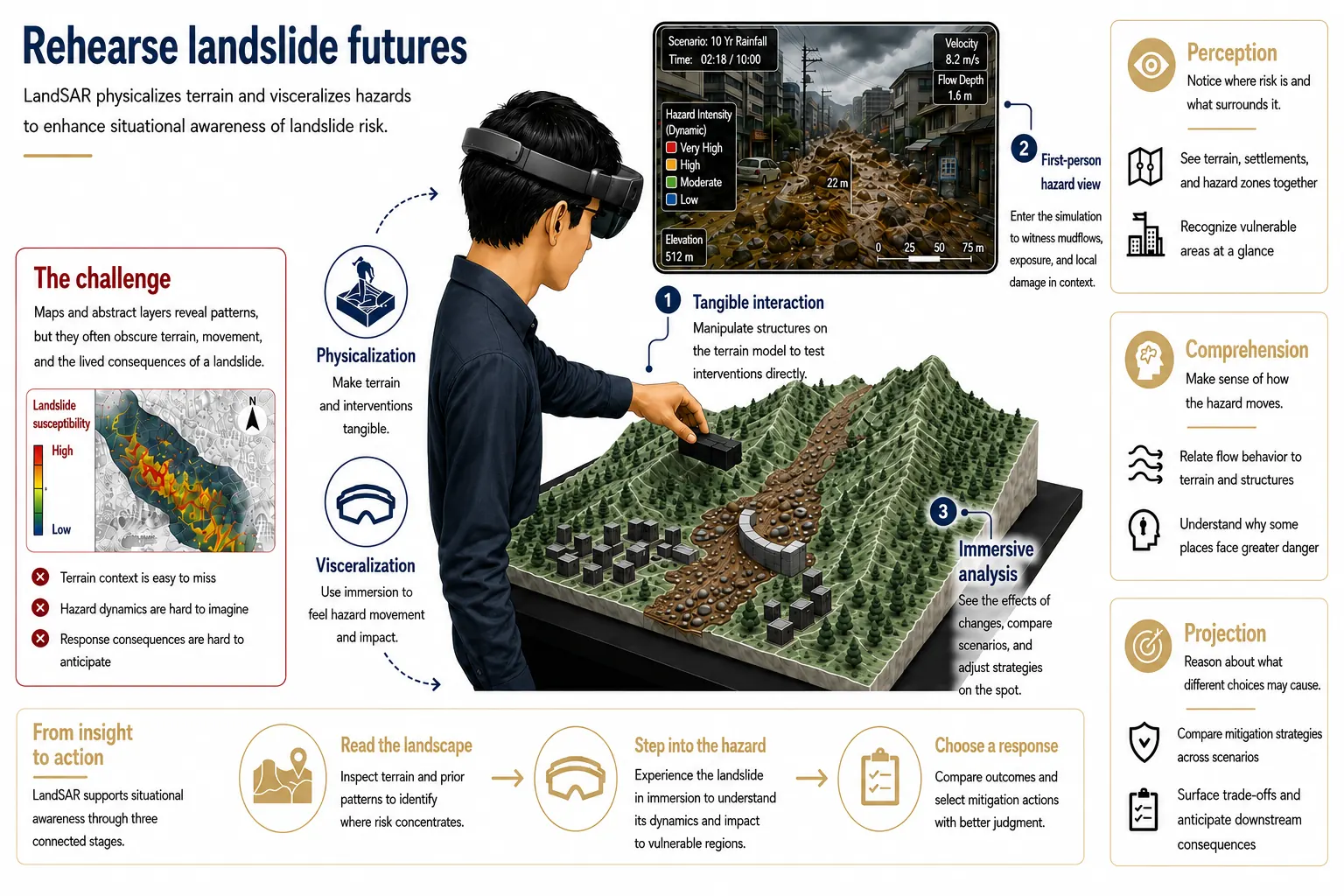
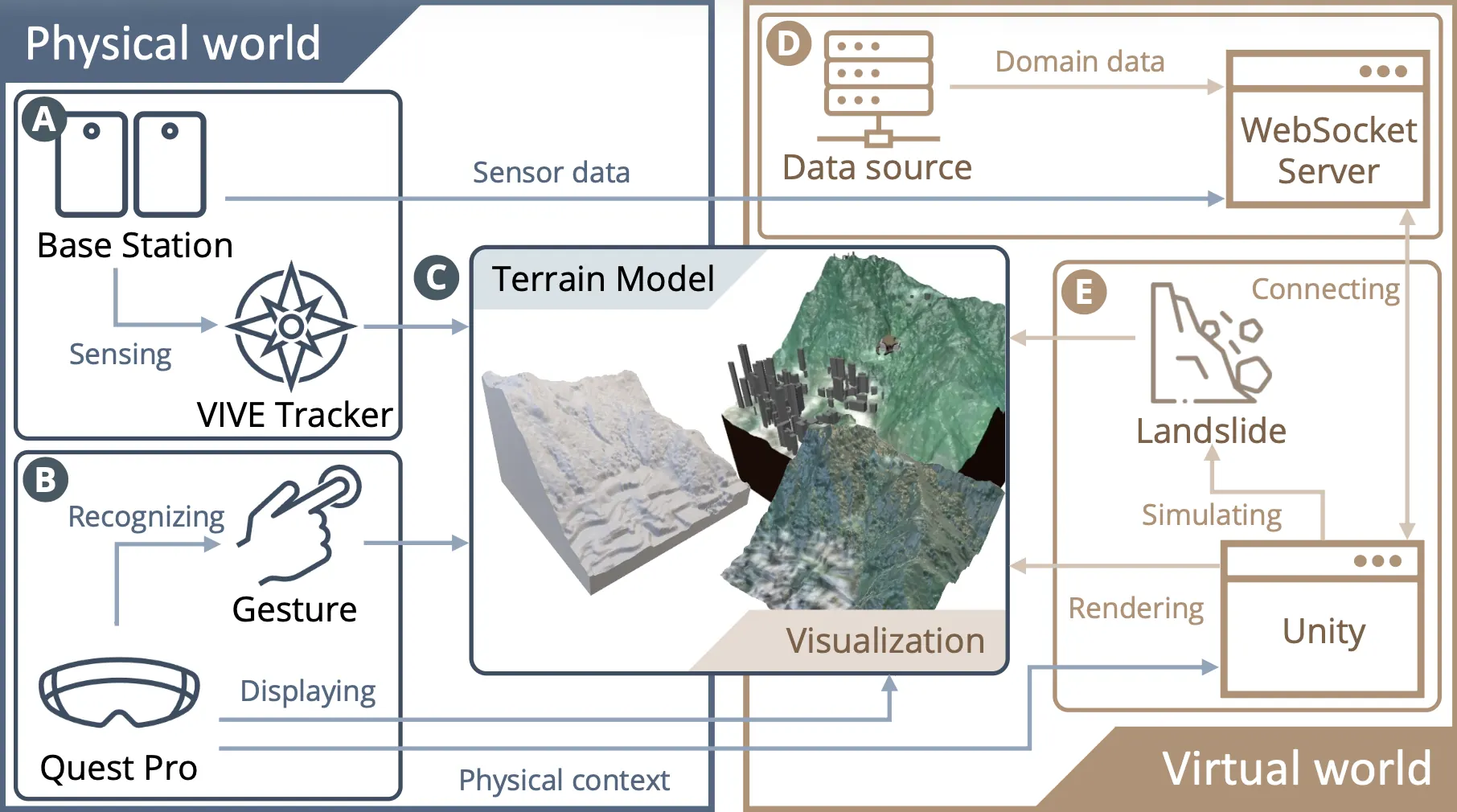
LandSAR: Visceralizing Landslide Data for Enhanced Situational Awareness in Immersive Analytics Lets planners rehearse landslide scenarios on a physical terrain model before disasters strike.
Human-AI Collaboration Workflows
I design visual and mixed-initiative workflows that make data, domain context, and analytic provenance easier to inspect, question, and communicate.
-
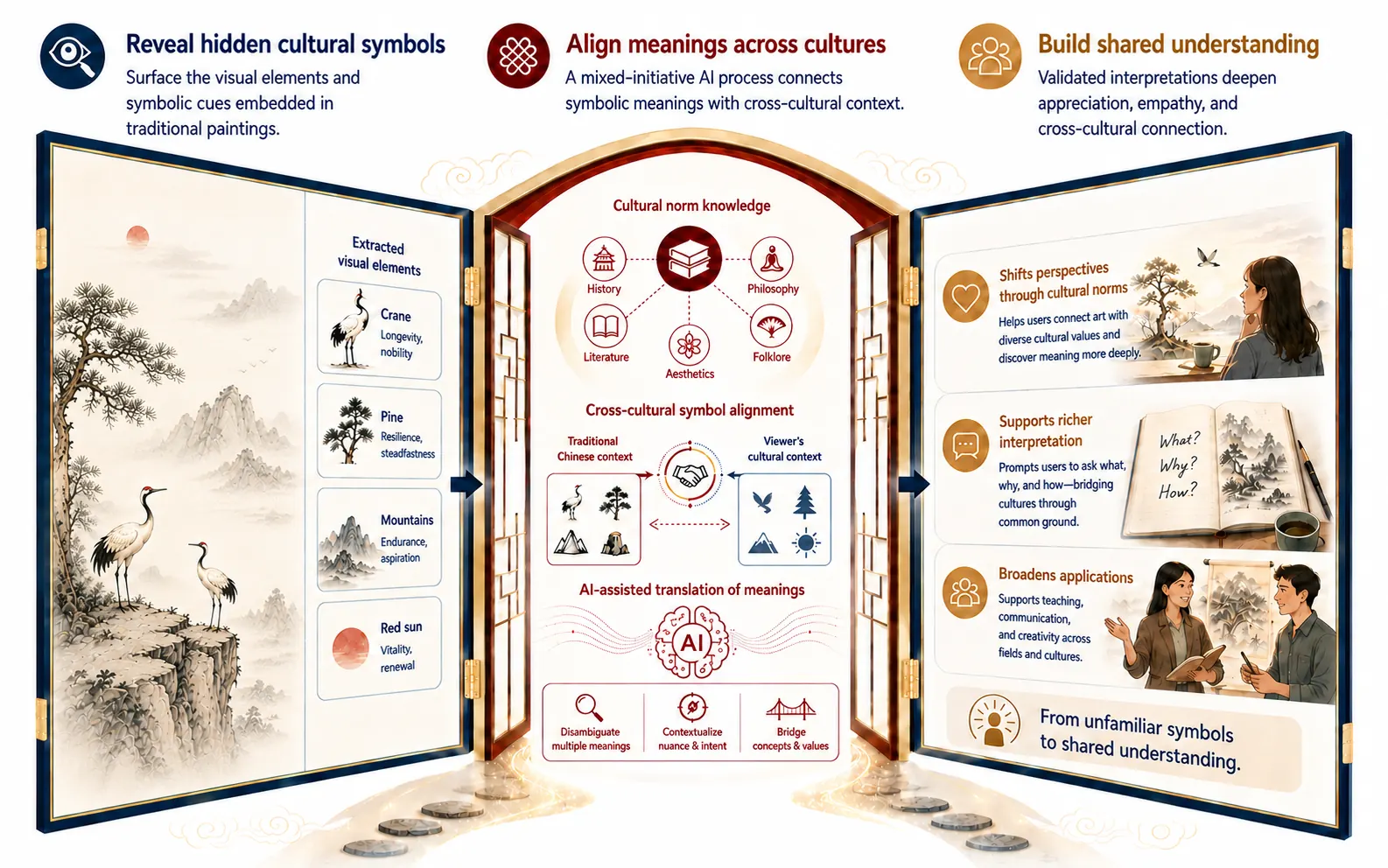
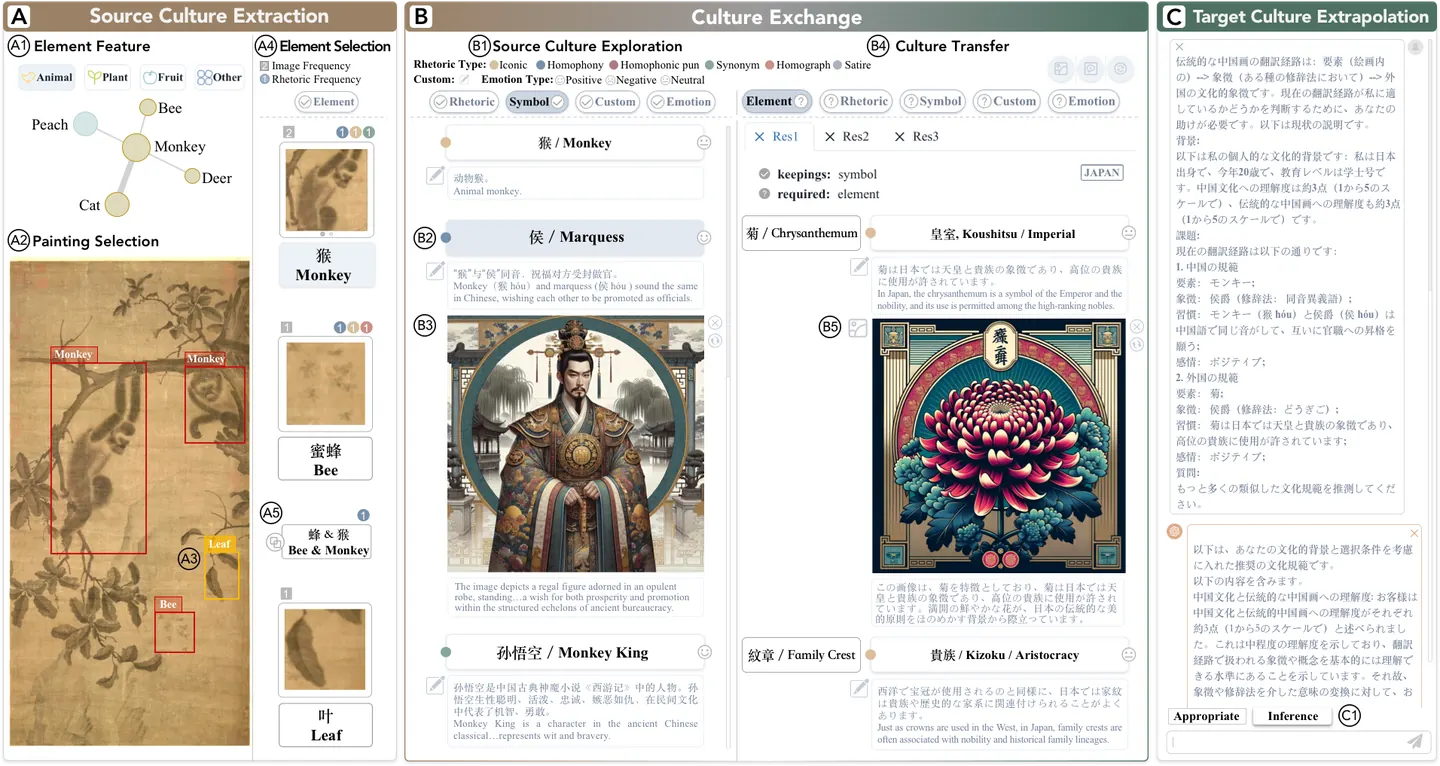
CultiVerse: Towards Cross-Cultural Understanding for Paintings with Large Language Model Makes culturally specific symbolism in paintings easier for outsiders to understand without flattening differences.
Visual Analytics Systems
I create visual analytics systems that help people compare alternatives, anticipate consequences, and plan under uncertainty.
-
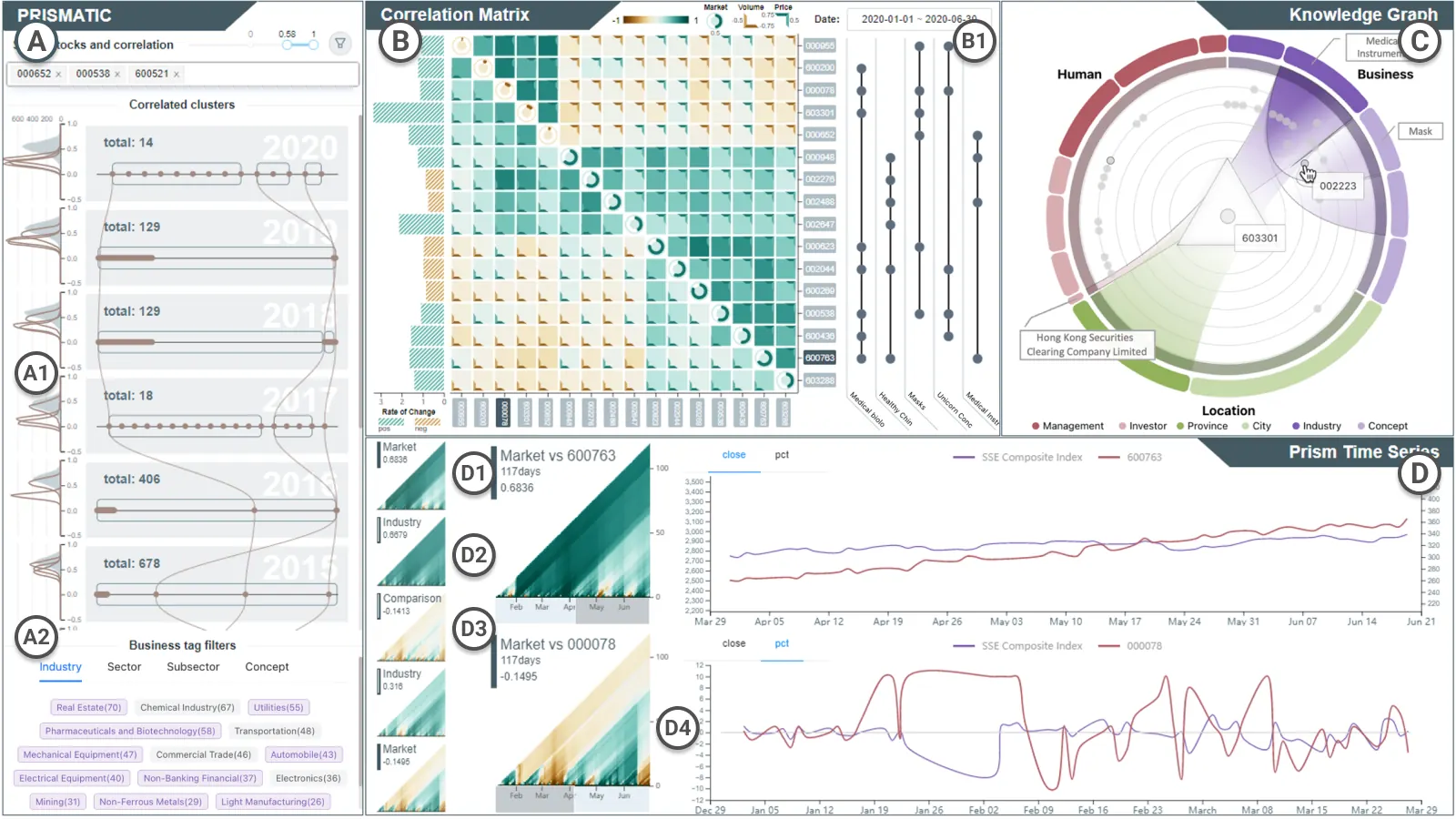
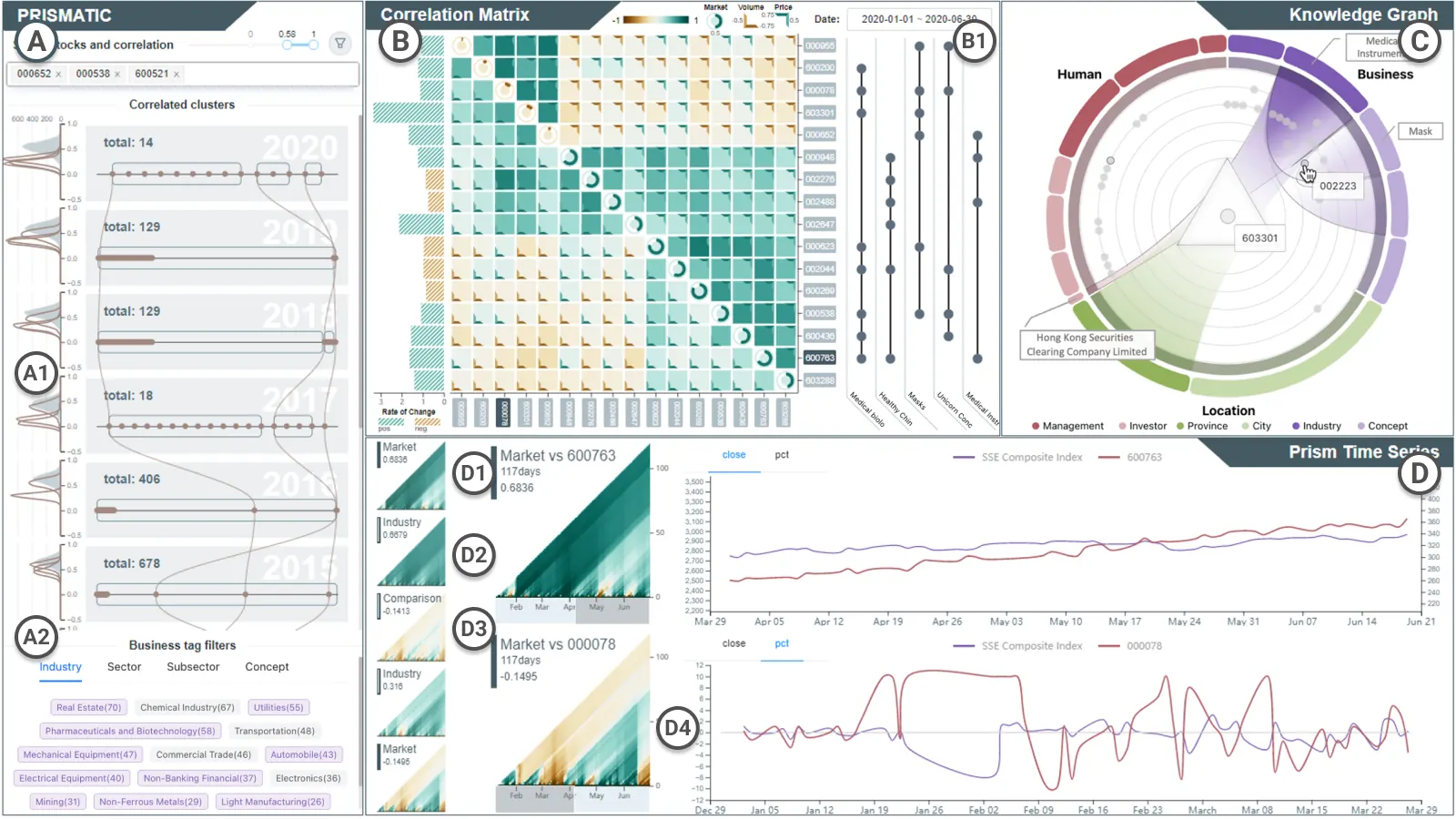
Prismatic: Interactive Multi-View Cluster Analysis of Concept Stocks Helps investors see why stocks belong together instead of trusting correlations alone.
Publication Archive
Publications
Use the themes and topic filters to browse the archive as one connected research program rather than a set of unrelated projects.
Selected Publications
2026
-
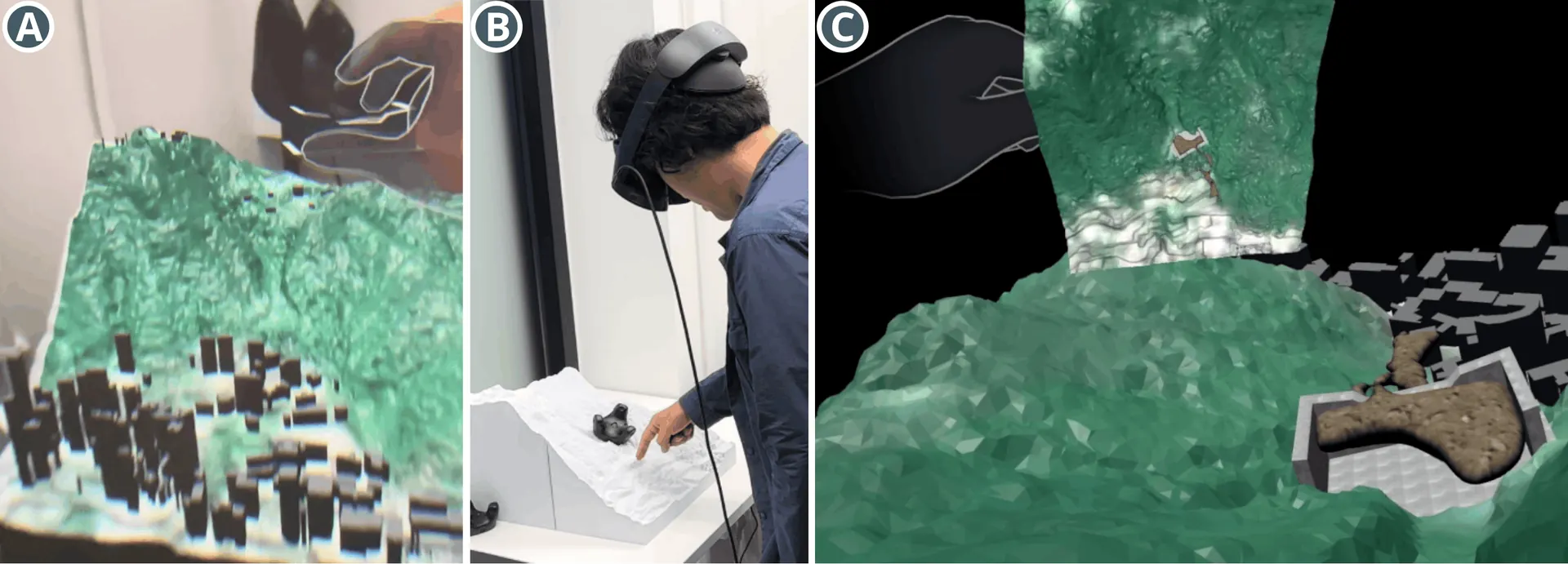
PacificVisImmersive AnalyticsLandSAR: Visceralizing Landslide Data for Enhanced Situational Awareness in Immersive Analytics
Lets planners rehearse landslide scenarios on a physical terrain model before disasters strike.
Pairs real-time what-if landslide simulation with a tangible terrain interface, turning hazard assessment into prospective spatial reasoning for mitigation and situational awareness.
@article{wong2026landsar, author = {Kam-Kwai, Wong and Ye, Yi-Lin and Tong, Wai and Li, Haobo and Takahira, Kentaro and Bhatta, Aastha and Poudyal, Sunil and Ng, Charles Wang Wai and Qu, Huamin and Yang, Leni}, title = {LandSAR: Visceralizing Landslide Data for Enhanced Situational Awareness in Immersive Analytics}, journal = {IEEE Transactions on Visualization and Computer Graphics}, year = {2026}, note = {to appear} }
2025
-
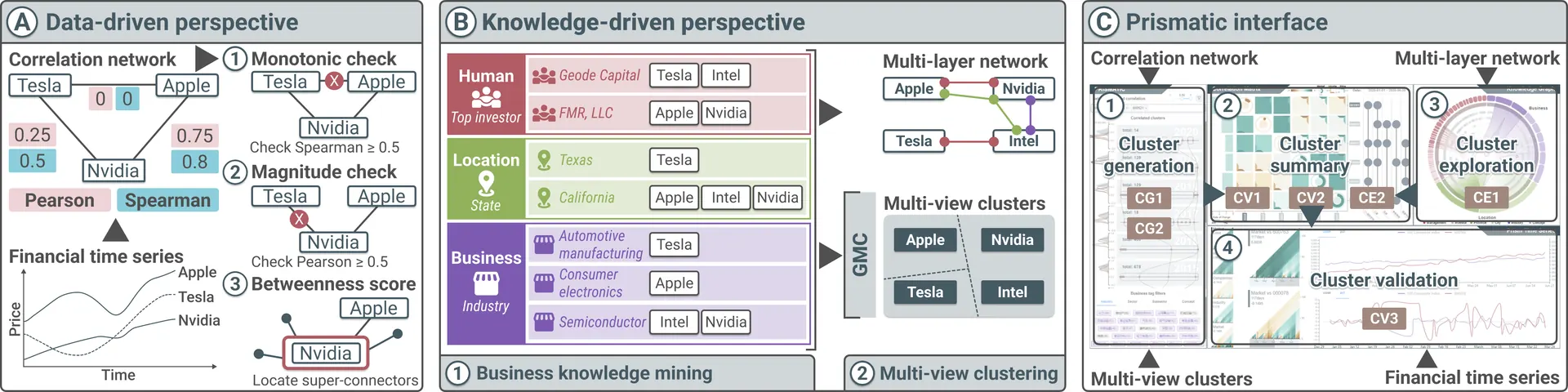
TVCGBusiness IntelligencePrismatic: Interactive Multi-View Cluster Analysis of Concept Stocks
Helps investors see why stocks belong together instead of trusting correlations alone.
Couples data-driven co-movement with explicit business relations so analysts can steer concept-stock generation, exploration, and validation across time horizons.
@article{wong2025prismatic, author = {Kam-Kwai, Wong and Luo, Yan and Yue, Xuanwu and Chen, Wei and Qu, Huamin}, title = {{Prismatic: Interactive Multi-View Cluster Analysis of Concept Stocks}}, journal = {IEEE Transactions on Visualization and Computer Graphics}, year = {2025}, pages = {1-14}, doi = {10.1109/TVCG.2025.3567084} } -
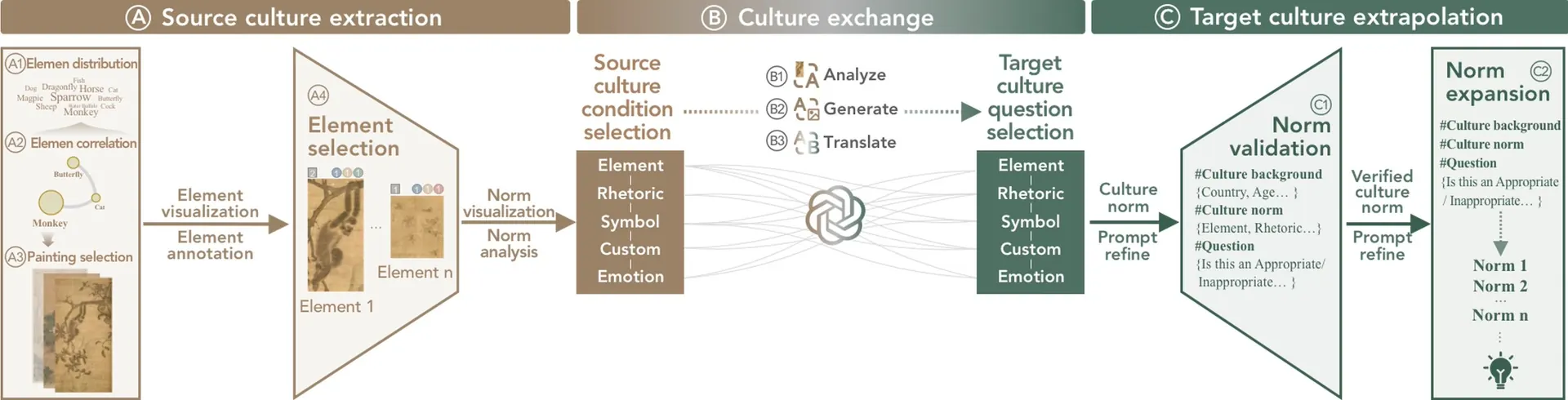
ACM MMDigital HumanitiesCultiVerse: Towards Cross-Cultural Understanding for Paintings with Large Language Model
Makes culturally specific symbolism in paintings easier for outsiders to understand without flattening differences.
Builds cross-cultural intelligibility through a mixed-initiative workflow and cultural-norm dataset that align symbols across cultures, surface context across visual/symbol/custom levels, and validate acceptable interpretations.
@inproceedings{zhang2025cultiverse, author = {Zhang, Wei and Kam-Kwai, Wong and Xu, Biying and Ren, Yiwen and Li, Yuhuai and Feng, Yingchaojie and Zhu, Minfeng and Chen, Wei}, title = {{CultiVerse: Towards Cross-Cultural Understanding for Paintings with Large Language Model}}, booktitle = {Proceedings of the ACM International Conference on Multimedia}, year = {2025}, isbn = {9798400720352}, publisher = {Association for Computing Machinery}, address = {New York, NY, USA}, url = {https://doi.org/10.1145/3746027.3755698}, doi = {10.1145/3746027.3755698}, pages = {6710-6719}, numpages = {10}, keywords = {cross-cultural understanding, human-ai collaboration, large language models, traditional chinese paintings, visual analytics}, location = {Dublin, Ireland}, series = {MM '25} } -
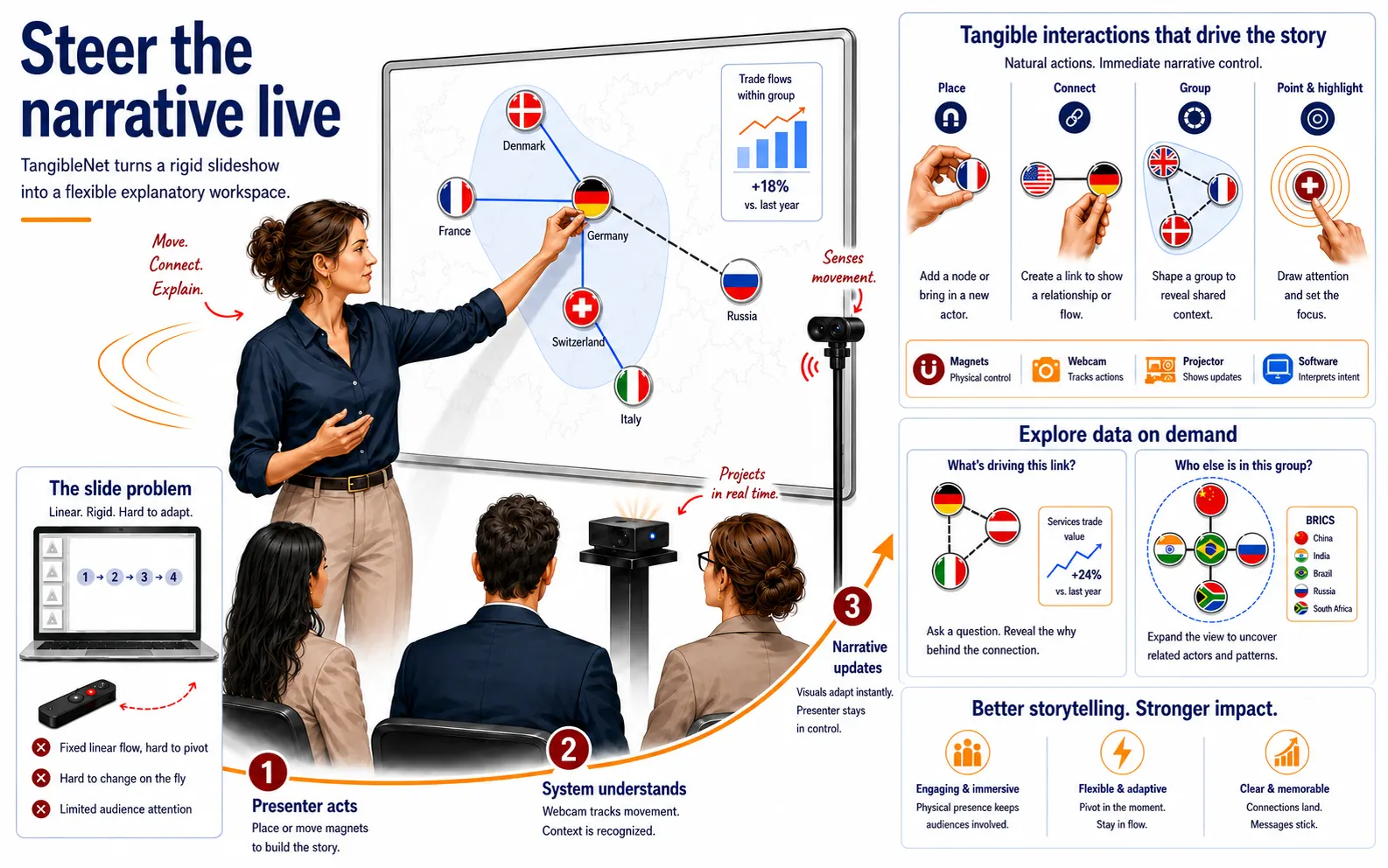
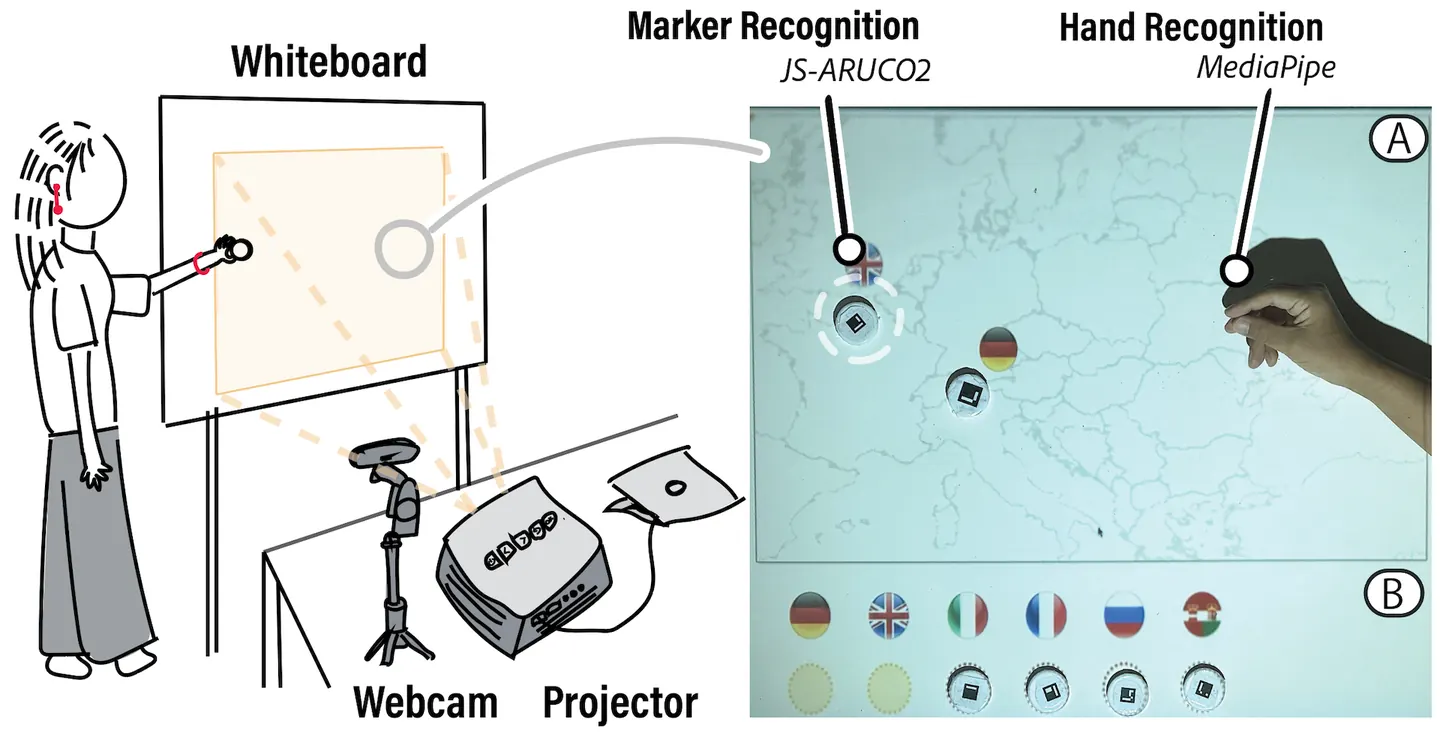
ACM CHIImmersive StorytellingTangibleNet: Synchronous Network Data Storytelling through Tangible Interactions in Augmented Reality
Gives live presenters a more natural way to manipulate network stories in space.
Maps tangible AR actions to node-link operations so presenters can steer synchronous network storytelling in real time without breaking presentation flow.
@inproceedings{kentaro2025tangiblenet, author = {Takahira, Kentaro and Kam-Kwai, Wong and Yang, Leni and Xu, Xian and Fujiwara, Takanori and Qu, Huamin}, title = {TangibleNet: Synchronous Network Data Storytelling through Tangible Interactions in Augmented Reality}, year = {2025}, isbn = {9798400713941}, publisher = {Association for Computing Machinery}, address = {New York, NY, USA}, url = {https://doi.org/10.1145/3706598.3714265}, doi = {10.1145/3706598.3714265}, booktitle = {Proceedings of the CHI Conference on Human Factors in Computing Systems}, articleno = {233}, numpages = {18}, keywords = {data-driven storytelling, tangible interaction, augmented reality, network visualization}, series = {CHI '25} } -
TVCGLLMSave It for the “Hot” Day: An LLM-Empowered Visual Analytics System for Heat Risk Management
Helps heat-risk planning account for social context, not just weather forecasts.
Fuses numerical heat models with LLM-structured news evidence, creating a prospective decision space where experts can retrieve, align, and act on contextual risk signals for mitigation.
@article{li2025havior, author = {Li, Haobo and Kam-Kwai, Wong and Luo, Yan and Chen, Juntong and Liu, Chengzhong and Zhang, Yaxuan and Lau, Alexis Kai Hon and Qu, Huamin and Liu, Dongyu}, title = {{Save It for the ``Hot'' Day: An LLM-Empowered Visual Analytics System for Heat Risk Management}}, journal = {IEEE Transactions on Visualization and Computer Graphics}, year = {2025}, pages = {1-16}, doi = {10.1109/TVCG.2025.3586689} } -
ACM CHIImmersive StorytellingData Bias Recognition in Museum Settings: Framework Development and Contributing Factors
Shows how data exhibits can teach visitors to question bias instead of passively trust them.
Identifies familiarity as a key enabler of bias recognition and formalizes a three-layer framework for designing more critically intelligible AR data exhibitions.
@inproceedings{lima2025dataseum, author = {Quinto Lima, Stella and Buraglia, Gabriela and Kam-Kwai, Wong and Roberts, Jessica}, title = {Data Bias Recognition in Museum Settings: Framework Development and Contributing Factors}, year = {2025}, isbn = {9798400713941}, publisher = {Association for Computing Machinery}, address = {New York, NY, USA}, url = {https://doi.org/10.1145/3706598.3714092}, doi = {10.1145/3706598.3714092}, booktitle = {Proceedings of the CHI Conference on Human Factors in Computing Systems}, articleno = {229}, numpages = {15}, keywords = {Prior Knowledge, Human-Data Interaction, Augmented Reality, Critical Thinking, Informal Learning, Human-Centered Computing}, series = {CHI '25} } -
ACM CHIImmersive StorytellingEgo vs. Exo and Active vs. Passive: Investigating the Individual and Combined Effects of Viewpoint and Navigation on Spatial Immersion and Understanding in Immersive Storytelling
Shows when immersive stories should give audiences control and when they should guide them.
Separates the effects of viewpoint and navigation in immersive storytelling, showing how egocentric+active boosts agency while exocentric+passive preserves focus on story content.
@inproceedings{lu2025viewpoint, author = {Lu, Tao and Zhu, Qian and Ma, Tiffany and Kam-Kwai, Wong and Xie, Anlan and Endert, Alex and Yang, Yalong}, title = {Ego vs. Exo and Active vs. Passive: Investigating the Individual and Combined Effects of Viewpoint and Navigation on Spatial Immersion and Understanding in Immersive Storytelling}, year = {2025}, isbn = {9798400713941}, publisher = {Association for Computing Machinery}, address = {New York, NY, USA}, url = {https://doi.org/10.1145/3706598.3713849}, doi = {10.1145/3706598.3713849}, booktitle = {Proceedings of the CHI Conference on Human Factors in Computing Systems}, articleno = {976}, numpages = {19}, keywords = {Immersive storytelling, Story navigation, Story viewpoint in immersive environments}, series = {CHI '25} } -
TVCGCross RealityExploring Spatial Hybrid User Interface for Visual Sensemaking
Shows that combining desktop precision with VR space can improve analytic work without costly switching.
Distributes visual sensemaking across PC and VR, letting users combine desktop precision with spatial overview rather than forcing one device to do both.
@inproceedings{tong2025hybrid, author = {Tong, Wai and Li, Haobo and Xia, Meng and Kam-Kwai, Wong and Pong, Ting-Chuen and Qu, Huamin and Yang, Yalong}, title = {{Exploring Spatial Hybrid User Interface for Visual Sensemaking}}, journal = {IEEE Transactions on Visualization and Computer Graphics}, pages = {1-16}, year = {2025}, doi = {10.1109/TVCG.2025.3538771} } -
C&GInformation VisualizationCausalPrism: A Visual Analytics Approach for Subgroup-based Causal Heterogeneity Exploration
Helps researchers see who benefits from a treatment and how reliable that pattern is.
Combines Pareto-optimized, rule-explained subgroup discovery with interactive ranking and uncertainty views, turning subgroup HTE exploration into a steerable trade-off space.
@article{zhou2025causalprism, author = {Liu, Xingyu and Zhou, Jiehui and Wang, Xumeng and Kam-Kwai, Wong and Zhang, Wei and Liu, Xingyu and Zhang, Juntian and Zhu, Minfeng and Chen, Wei}, title = {{CausalPrism: A Visual Analytics Approach for Subgroup-based Causal Heterogeneity Exploration}}, journal = {Computers \& Graphics}, volume = {131}, pages = {104356}, year = {2025}, issn = {0097-8493}, doi = {10.1016/j.cag.2025.104356} } -
VIBusiness IntelligenceFundSelector: A visual analysis system for mutual fund selection
Helps ordinary investors choose funds that match their priorities rather than generic rankings.
Quantifies investor preferences and exposes factor-level reasons and temporal trade-offs behind each ranking, making mutual fund selection steerable rather than one-size-fits-all.
@article{yan2025fundselector, title = {FundSelector: A visual analysis system for mutual fund selection}, journal = {Visual Informatics}, volume = {9}, number = {4}, pages = {100258}, year = {2025}, issn = {2468-502X}, doi = {https://doi.org/10.1016/j.visinf.2025.100258}, author = {Yan, Fan and Wang, Yong and Yue, Xuanwu and Kam-Kwai, Wong and Mao, Ketian and Zhang, Rong and Qu, Huamin and Zhu, Haiyang and Zhu, Minfeng and Chen, Wei} }
2024
-
PacificVisDigital HumanitiesScrollTimes: Tracing the Provenance of Paintings as a Window into History
Turns a painting’s scattered traces into a readable life history.
Structures provenance as a three-level biography workflow linking extracted visual evidence, validated historical context, and temporal transmission into customizable handscroll histories.
@article{zhang2024scrolltimes, author = {Zhang, Wei and Kam-Kwai, Wong and Chen, Yitian and Jia, Ailing and Wang, Luwei and Zhang, Jian-Wei and Cheng, Lechao and Qu, Huamin and Chen, Wei}, title = {ScrollTimes: Tracing the Provenance of Paintings as a Window into History}, journal = {IEEE Transactions on Visualization and Computer Graphics}, year = {2023}, volume = {30}, number = {6}, pages = {2981-2994}, doi = {10.1109/TVCG.2024.3388523} } -
JCSTDigital HumanitiesComputational Approaches for Traditional Chinese Painting: From the “Six Principles of Painting” Perspective
Shows where computing has and has not yet engaged the core ideas of Chinese painting.
Re-reads 92 papers through the Six Principles and application stages, turning computational TCP into a prospecting map of underexplored artistic dimensions.
@article{zhang2024tcp, author = {Zhang, Wei and Zhang, Jianwei and Kam-Kwai, Wong and Wang, Yifang and Feng, Yingchaojie and Wang, Luwei and Chen, Wei}, title = {{Computational Approaches for Traditional Chinese Painting: From the ``Six Principles of Painting'' Perspective}}, journal = {Journal of Computer Science and Technology}, year = {2024}, doi = {10.1007/s11390-024-3408-x}, } -
Info VisLLMTowards an Understanding and Explanation for Mixed-Initiative Artificial Scientific Text Detection
Makes AI-text detection more trustworthy by showing what cues drive the judgment.
Combines human priors, model evidence, and contribution-based explanations in a mixed-initiative workflow that makes scientific-text detection more intelligible and trustworthy.
@article{weng2024artificialtextdetection, author = {Weng, Luoxuan and Liu, Shi and Zhu, Hang and Sun, Jiashun and Kam-Kwai, Wong and Han, Dongming and Zhu, Minfeng and Chen, Wei}, title = {{Towards an Understanding and Explanation for Mixed-Initiative Artificial Scientific Text Detection}}, journal = {Information Visualization}, year = {2024}, doi = {10.1177/14738716241240156} } -
TVCGBusiness IntelligenceFMLens: Towards Better Scaffolding the Process of Fund Manager Selection in Fund Investments
Helps investors judge fund managers on style and skill instead of headline returns alone.
Decomposes fund managers’ styles, abilities, and performance persistence into linked views that make selection more intelligible than comparing headline returns alone.
@article{chen2024fmlens, author = {Chen, Longfei and Cheng, Chen and Wang, He and Wang, Xiyuan and Tian, Yun and Yue, Xuanwu and Kam-Kwai, Wong and Zhang, Haipeng and Hong, Suting and Li, Quan}, title = {{FMLens: Towards Better Scaffolding the Process of Fund Manager Selection in Fund Investments}}, journal = {IEEE Transactions on Visualization and Computer Graphics}, year = {2024}, pages = {1-17}, doi = {10.1109/TVCG.2024.3394745} }
2023
-
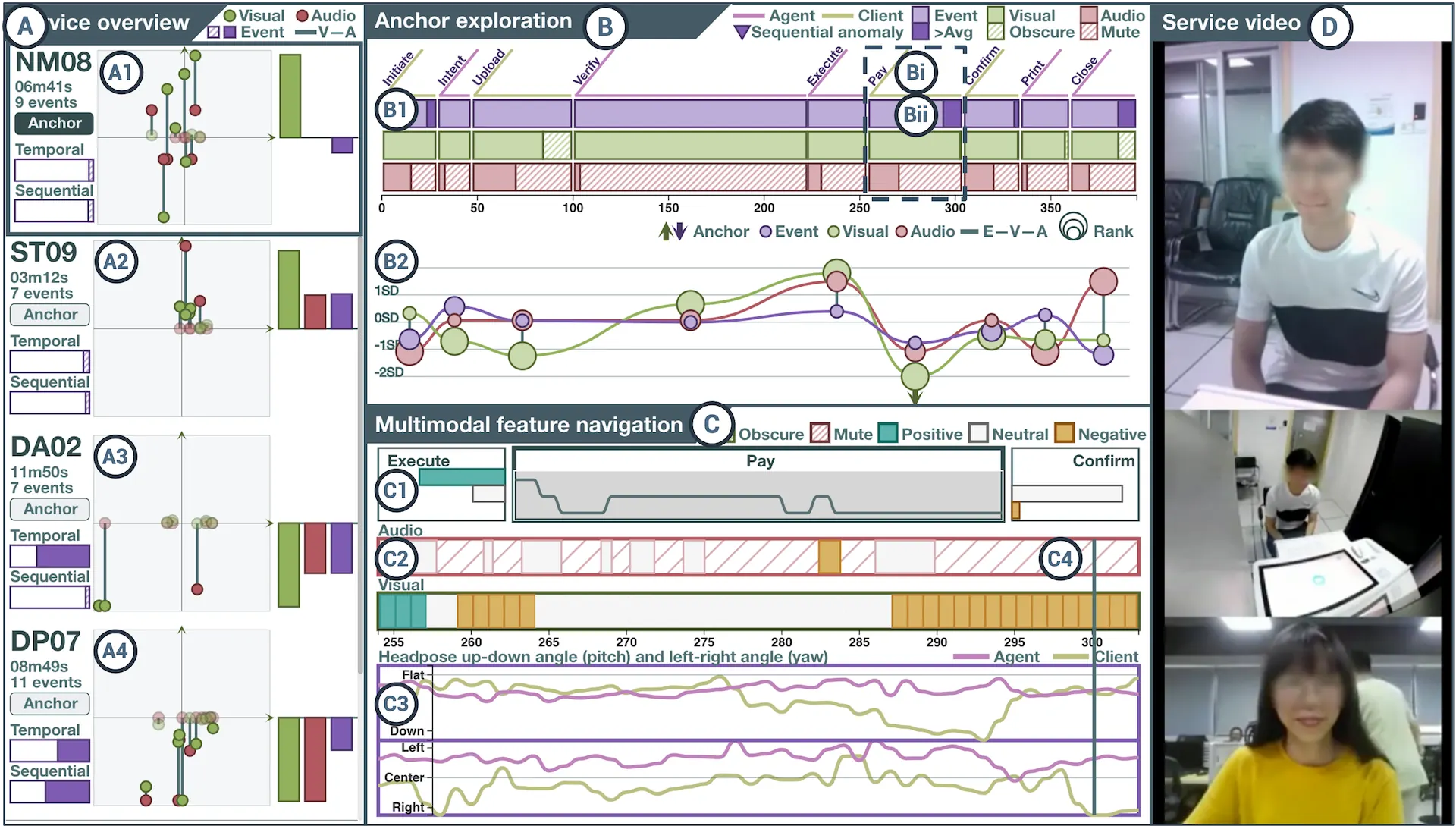
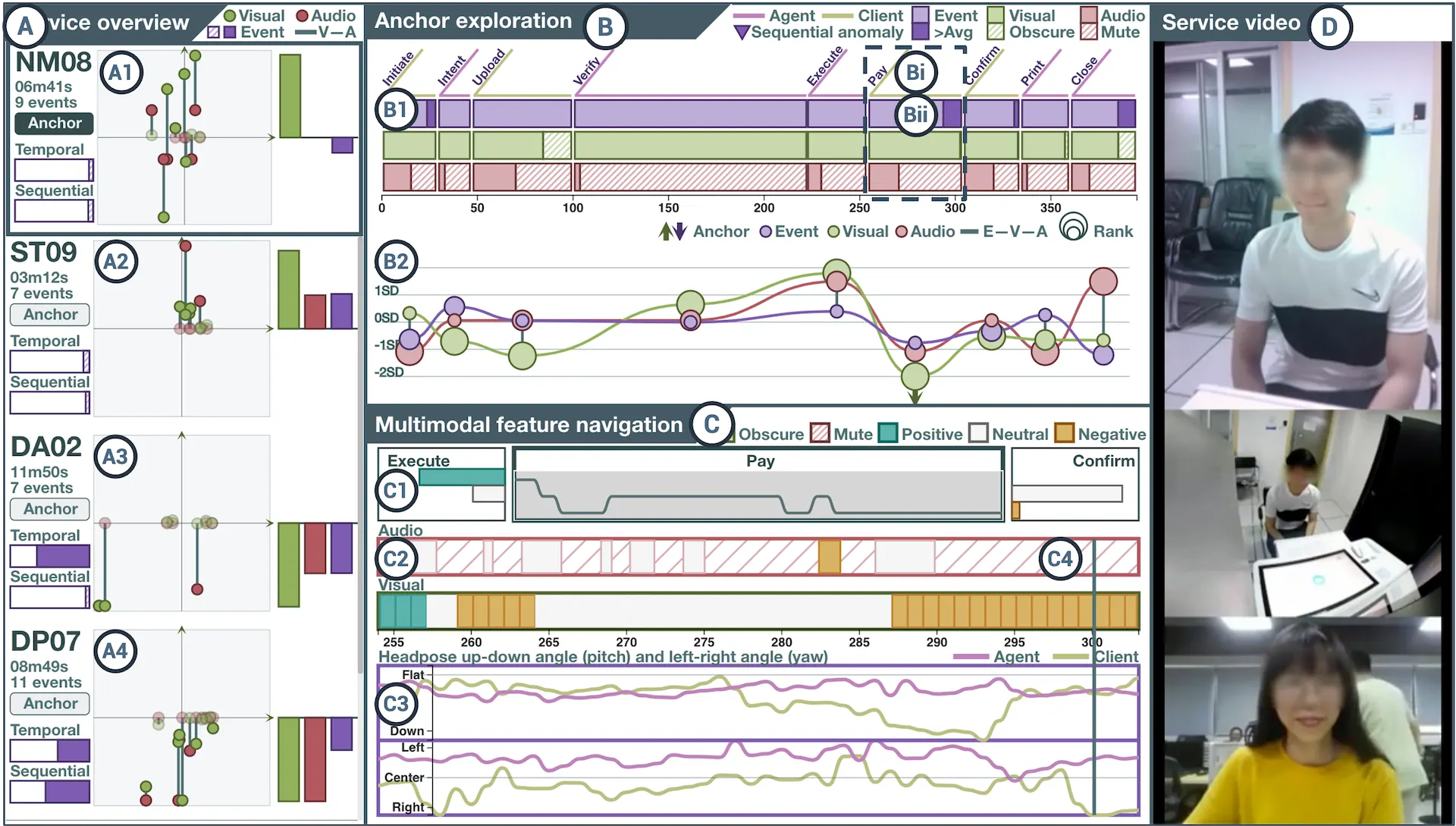
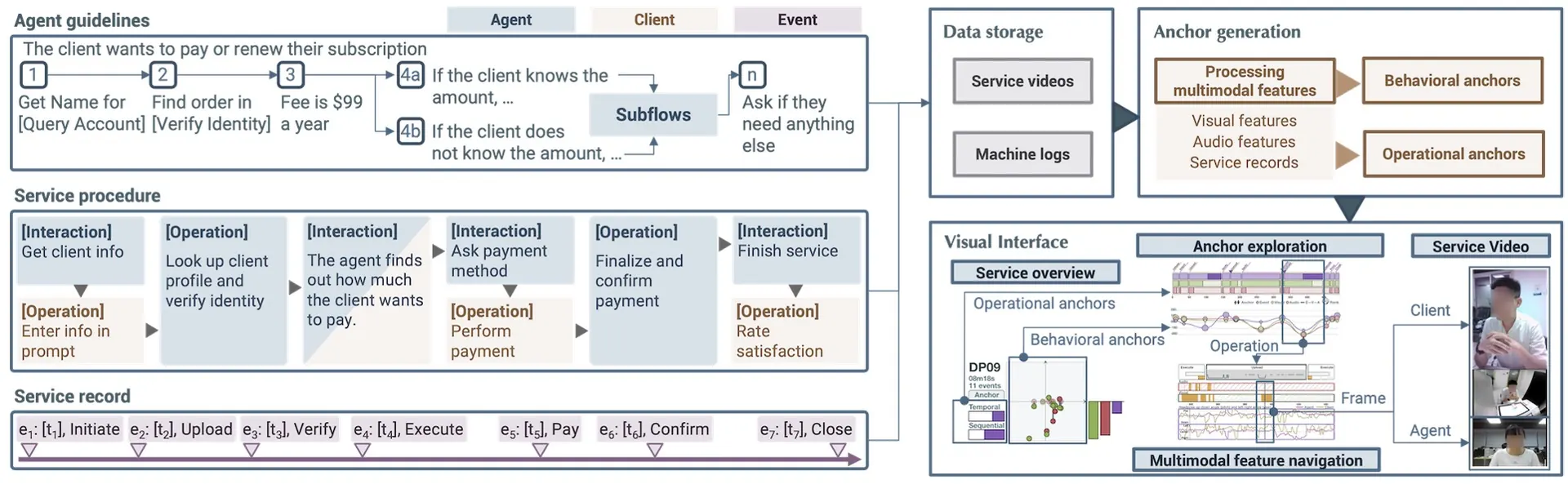
TVCGBusiness IntelligenceAnchorage: Visual Analysis of Satisfaction in Customer Service Videos via Anchor Events
Turns long service videos into readable evidence for where satisfaction breaks down.
Anchors multimodal behavior to semantically meaningful service events, letting analysts navigate long videos directly through operational causes of satisfaction change.
@article{wong2023anchorage, author = {Kam-Kwai, Wong and Wang, Xingbo and Wang, Yong and He, Jianben and Zhang, Rong and Qu, Huamin}, title = {{Anchorage: Visual Analysis of Satisfaction in Customer Service Videos via Anchor Events}}, journal = {IEEE Transactions on Visualization and Computer Graphics}, year = {2024}, volume = {30}, number = {7}, pages = {4008-4022}, doi = {10.1109/TVCG.2023.3245609} } -
IEEE VISLLMPromptMagician: Interactive Prompt Engineering for Text-to-Image Creation
Helps novices turn vague image ideas into prompts they can deliberately refine.
Retrieves similar prompt-image examples, surfaces influential keywords, and visualizes cross-modal neighborhoods so users can steer prompt refinement for text-to-image creation.
@article{feng2023promptmagician, author = {Feng, Yingchaojie and Wang, Xingbo and Kam-Kwai, Wong and Wang, Sijia and Lu, Yuhong and Zhu, Minfeng and Wang, Baicheng and Chen, Wei}, journal = {IEEE Transactions on Visualization and Computer Graphics}, title = {{PromptMagician: Interactive Prompt Engineering for Text-to-Image Creation}}, year = {2024}, volume = {30}, number = {1}, pages = {295-305}, doi = {10.1109/TVCG.2023.3327168}, } -
IEEE VISInformation VisualizationVideoPro: A Visual Analytics Approach for Interactive Video Programming
Lets experts build video labels faster while keeping control over what the model learns.
Turns detected video events into reusable labeling-function templates and exposes their downstream effect on model performance, enabling steerable video data programming.
@article{he2023videopro, author = {He, Jianben and Wang, Xingbo and Kam-Kwai, Wong and Huang, Xijie and Chen, Changjian and Chen, Zixin and Wang, Fengjie and Zhu, Min and Qu, Huamin}, title = {{VideoPro: A Visual Analytics Approach for Interactive Video Programming}}, journal = {IEEE Transactions on Visualization and Computer Graphics}, year = {2024}, volume = {30}, number = {1}, pages = {87-97}, doi = {10.1109/TVCG.2023.3326586}, } -
IEEE VRCross RealityTowards an Understanding of Distributed Asymmetric Collaborative Visualization on Problem-solving
Shows mixed PC-VR teams can work effectively without everyone using the same device.
Compares asymmetric PC-VR with symmetric setups and iterates the interface to show how distributed teams can steer role split, effort, and coordination across devices.
@inproceedings{tong2023asymcollab, author = {Tong, Wai and Xia, Meng and Kam-Kwai, Wong and Bowman, Doug A and Pong, Ting-Chuen and Qu, Huamin and Yang, Yalong}, title = {{Towards an Understanding of Distributed Asymmetric Collaborative Visualization on Problem-solving}}, booktitle = {IEEE Conference Virtual Reality and 3D User Interfaces (VR)}, year = {2023}, pages = {387-397}, doi = {10.1109/VR55154.2023.00054}, } -
TVCGLLMXNLI: Explaining and Diagnosing NLI-based Visual Data Analysis
Shows users why a natural-language chart request went wrong and how to fix it.
Exposes provenance across attributes, tasks, and encodings, then couples those explanations with interactive fixes and query-revision hints for intelligible NLI analysis.
@article{feng2023xnli, author = {Feng, Yingchaojie and Wang, Xingbo and Pan, Bo and Kam-Kwai, Wong and Ren, Yi and Liu, Shi and Yan, Zihan and Ma, Yuxin and Qu, Huamin and Chen, Wei}, title = {{XNLI: Explaining and Diagnosing NLI-based Visual Data Analysis}}, journal = {IEEE Transactions on Visualization and Computer Graphics}, year = {2023}, pages = {1-14}, doi = {10.1109/TVCG.2023.3240003}, } -
VIBusiness IntelligenceTax-Scheduler: An Interactive Visualization System for Staff Shifting and Scheduling at Tax Authorities
Helps tax offices plan staffing ahead of demand instead of reacting after queues form.
Couples client-inflow prediction with interactive staff-scheduling optimization, turning historical demand into prospective staffing plans for tax service operations.
@article{yuan2023taxscheduler, title = {{Tax-Scheduler: An Interactive Visualization System for Staff Shifting and Scheduling at Tax Authorities}}, author = {Yuan, Linping and Li, Boyu and Li, Siqi and Kam-Kwai, Wong and Zhang, Rong and Qu, Huamin}, year = {2023}, month = jun, journal = {Visual Informatics}, volume = {7}, number = {2}, pages = {30--40}, issn = {2468-502X}, doi = {10.1016/j.visinf.2023.02.001} } -
ChinaVisBusiness IntelligenceVisual Analytics for Security Threats Detection in Ethereum Consensus Layer
Makes hidden beacon-chain attacks easier for developers to notice and investigate.
Links system-level security state to slot-level consensus outcomes and attack-specific anomalies, making Ethereum consensus threats intelligible to developers.
@article{chen2024ethereum, author = {Chen, Xuan and Zhang, Xincan and Wang, Zhaohan and Yu, Kerun and Kam-Kwai, Wong and Guo, Haoyun and Chen, Siming}, title = {{Visual Analytics for Security Threats Detection in Ethereum Consensus Layer}}, journal = {Journal of Visualization}, year = {2024}, month = mar, doi = {10.1007/s12650-024-00969-z} }
2022
-
IEEE VISDigital HumanitiesCohortVA: A Visual Analytic System for Interactive Exploration of Cohorts based on Historical Data
Helps historians test and refine groupings of historical figures instead of accepting opaque mining results.
Combines knowledge-graph candidates with interactive views that let historians authenticate figures, compare cohort features, and iterate hypotheses across space and time.
@article{zhang2023cohortva, author = {Zhang, Wei and Kam-Kwai, Wong and Wang, Xumeng and Gong, Youcheng and Zhu, Rongchen and Liu, Kai and Yan, Zihan and Tan, Siwei and Qu, Huamin and Chen, Siming and Chen, Wei}, title = {{CohortVA: A Visual Analytic System for Interactive Exploration of Cohorts based on Historical Data}}, journal = {IEEE Transactions on Visualization and Computer Graphics}, year = {2023}, volume = {29}, number = {1}, pages = {756-766}, doi = {10.1109/TVCG.2022.3209483}, } -
IEEE VISInformation VisualizationDPVisCreator: Incorporating Pattern Constraints to Privacy-preserving Visualizations via Differential Privacy
Lets organizations publish private charts without blindly destroying the patterns they care about.
Injects user-specified pattern constraints into a differential-privacy model so privacy-preserving charts remain steerable around the visual patterns users care about.
@article{zhou2023dpviscreator, author = {Zhou, Jiehui and Wang, Xumeng and Kam-Kwai, Wong and Wang, Huanliang and Wang, Zhongwei and Yang, Xiaoyu and Yan, Xiaoran and Feng, Haozhe and Qu, Huamin and Ying, Haochao and Chen, Wei}, title = {{DPVisCreator: Incorporating Pattern Constraints to Privacy-preserving Visualizations via Differential Privacy}}, journal = {IEEE Transactions on Visualization and Computer Graphics}, year = {2023}, volume = {29}, number = {1}, pages = {809-819}, doi = {10.1109/TVCG.2022.3209391}, }
2021
-
TVCGInformation VisualizationExplaining with Examples Lessons Learned from Crowdsourced Introductory Description of Information Visualizations
Shows that concrete examples help people learn to read charts.
Validates example-based introduction strategies as an effective way to teach visual encodings, making chart explanations more intelligible than abstract descriptions alone.
@article{yang2023explaining, author = {Yang, Leni and Xiong, Cindy and Kam-Kwai, Wong and Wu, Aoyu and Qu, Huamin}, title = {{Explaining with Examples Lessons Learned from Crowdsourced Introductory Description of Information Visualizations}}, journal = {IEEE Transactions on Visualization and Computer Graphics}, year = {2023}, volume = {29}, number = {3}, pages = {1638-1650}, doi = {10.1109/TVCG.2021.3128157}, } -
ChinaVisDigital HumanitiesiPoet: Interactive Painting Poetry Creation with Visual Multimodal Analysis
Lets non-experts co-create poems that respond to what a painting depicts and expresses.
Grounds poetry generation in extracted visual content and inferred emotion, then lets users guide the resulting poetic interpretation of ancient paintings.
@article{feng2022ipoet, title = {{iPoet: Interactive Painting Poetry Creation with Visual Multimodal Analysis}}, author = {Feng, Yingchaojie and Chen, Jiazhou and Huang, Keyu and Kam-Kwai, Wong and Ye, Hui and Zhang, Wei and Zhu, Rongchen and Luo, Xiaonan and Chen, Wei}, journal = {Journal of Visualization}, year = {2022}, month = jun, volume = {25}, number = {3}, pages = {671-685}, doi = {10.1007/s12650-021-00780-0}, }
2020
-
IEEE VISBusiness IntelligenceTaxThemis: Interactive Mining and Exploration of Suspicious Tax Evasion Groups
Makes group tax-evasion schemes visible as connected patterns rather than isolated suspicious transactions.
Fuses ownership and trade networks with evidence views that expose suspicious group structure, profit flow, and transfer patterns in related-party tax evasion.
@article{lin2021taxthemis, title = {{TaxThemis: Interactive Mining and Exploration of Suspicious Tax Evasion Groups}}, author = {Lin*, Yating and Kam-Kwai*, Wong and Wang, Yong and Zhang, Rong and Dong, Bo and Qu, Huamin and Zheng, Qinghua}, journal = {IEEE Transactions on Visualization and Computer Graphics}, year = {2021}, volume = {27}, number = {2}, pages = {849-859}, doi = {10.1109/TVCG.2020.3030370}, }
Systems and Prototypes
Projects
Selected systems that translate the research agenda into working interfaces, experiences, and deployable tools.
Application
Saving Hilly
The AR mini game for immersive landslide experience with life-saving messages